Tag: urban design

  • Three Ways to Remove Barriers to Affordable Housing in Urban Neighborhoods

    Note: this post was originally published on the FORM Coalition blog in January 2021. Since then, Strong Towns has launched their Housing Ready Cities resource, which includes these three policy initiatives as well as three others that together make it easier to build more homes on a local level.

    Here are three things every city can do to help make it easier to build more affordable homes:

    1. Eliminate minimum lot size requirements

    • Minimum lot sizes are an outdated holdover from single-family zoning, designed to space houses apart from each other and avoid density. Green space has been shown to be essential to public health and wellness, but instead of prescribing a minimum lot size, require a percentage of open, green space. Let the market drive unit size and quality design–look up cottage cluster housing for some inspiration.

    2. Legalize up to four units on any residential lot

    • Why four? Financing. Multi-family homes up to four units can be purchased with a conventional mortgage. Once you hit five units, you’re in commercial real estate territory.
    • Also, four units is a nice, inoffensive scale for many urban American neighborhoods. My own city of Richmond has fourplexes sprinkled throughout its most desirable neighborhoods; your city probably does too. Check out missingmiddlehousing.com for some more charming examples.
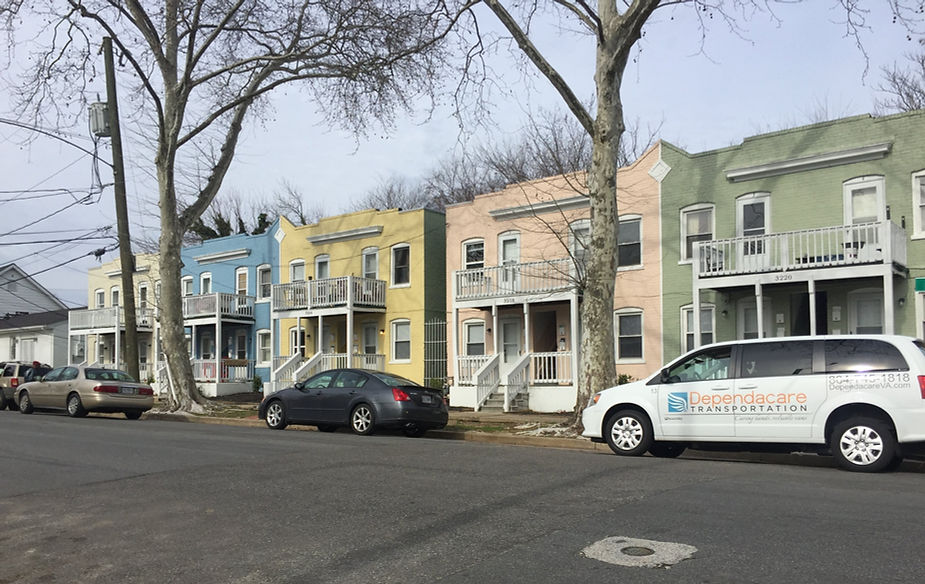
    Painted brick fourplexes in Church Hill, Richmond VA

    3. Eliminate minimum parking requirements

    • Minimum parking requirements drive up the cost of a project and therefore rents by reducing the amount of leasable space on a parcel. Not all neighborhoods are equal in their need for parking–factors like walkability, access to daily essentials, and quality of public transit will allow more people to opt out of driving, or reduce the number of cars they own. Let the market drive the demand for parking spaces.

    American cities of all sizes and stripes are facing affordable housing shortages, many at crisis levels. There are many reasons for this, but one of them has to do with the way that our zoning laws were written and enacted throughout the middle of the 20th century. In most of the US, it’s effectively illegal to build anything other than a single-family home in many residential zones.

    The result is the world we inhabit today: large swaths of single-family homes not within walking distance of basic amenities like grocery stores, libraries, post offices, schools, shopping, and entertainment. As American culture has seen a surge in popularity and desirability of walkable urban neighborhoods, it’s become clear that there’s not enough housing in these neighborhoods to meet the demand.

    Here’s the rub: in nearly every municipality in the US, those zoning laws are still in place. So, while duplexes and quadplexes may still exist because they are “grandmothered” in, you can’t build new ones without asking the city for an exception to the zoning laws, which means added time and expense. Added time and expense means the project costs more, which means it has to sell or rent for more, so you end up with either A. “missing middle” housing at a high price point relative to its market context, or B. another large single-family home that can be built “by right.” In either case, new housing is more expensive than it otherwise needs to be, either because of the cost to execute the project or because of sheer square footage.

    Common sense tells us that larger homes are generally more expensive than smaller ones in the same market. However, family sizes are smaller than they were 50 years ago. The average American household size in 1960 was 3.29 people; in 2019 it was 2.61 (in Richmond it went from 3.3 to 2.37 over a similar time period). In Kronberg Urbanists + Architects’ analysis of their own Atlanta market, they discovered that a staggering 77% of households are made up of 1 or 2 people (as of 2014). Building smaller homes means we can build more homes and house more people in the same area than if we are building large homes. It also means that the homes are more affordable, relative to larger homes in the same market.
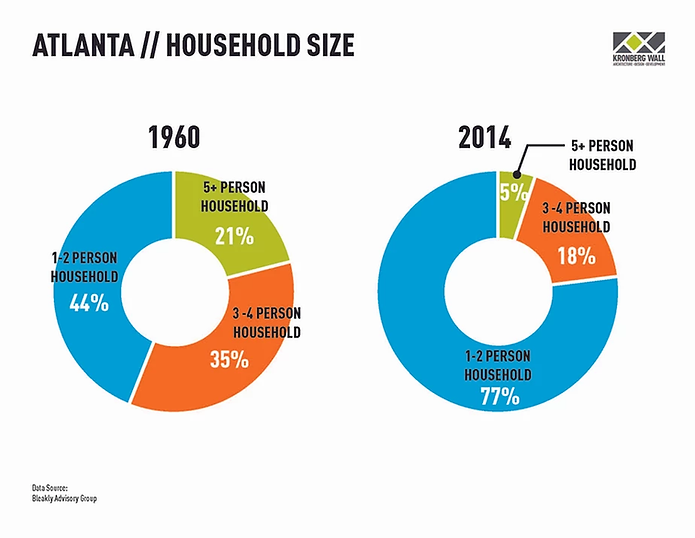
    Source: Kronberg Urbanists + Architects (Click the image to view their website)

    In summary: to build smaller, more affordable homes in urban neighborhoods, get rid of minimum lot size requirements, allow up to four units on any residential lot, and eliminate parking minimums. It won’t solve all of our urban housing problems, but it will make it easier to build quality, affordable housing in desirable neighborhoods.

    Sources & More Reading:

    Minimum Requirements for Lot and Building Size, American Planning Association (APA)

    Missing Middle Housing

    The Affordable Housing Crisis Explained, Curbed

    Cities Start to Question an American Ideal: A House With a Yard on Every Lot, New York Times

    Richmond 300: Land Use, Housing, & Demographic Analysis

    Housing Choice & Healthy Neighborhood Development, Kronberg Urbanists + Architects
  • Applying an Equity Lens to the 15-Minute City

    If you, like me, have been scrolling the internet a lot over the past year, you may have come across the term “15-Minute City,” or even (recently) its more provocative cousin, the “1-Minute City.”

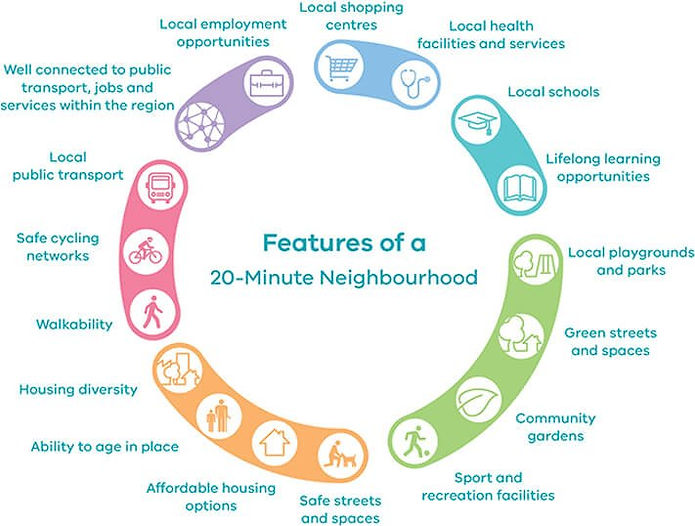
    The 15-minute city (or occasionally, the 20-minute city) is an urban planning concept that’s gained mainstream popularity as COVID-19 has forced lockdowns and reduced the distance of our daily travels. For many of us, our daily commute has completely evaporated, our worlds shrunk to our homes, makeshift home offices, the grocery store, the park. In the 15-minute city, you can access most or all of your day-to-day needs within a 15-minute walk, or about half a mile. This means groceries, banking, library, schools, restaurants and other “third places”, even your doctor’s office.

    The idea of the 15-Minute City was introduced by Carlos Moreno, a professor at the Sorbonne in France, as a way to structure communities for future sustainability. To be clear, he’s not the first person to advocate for organizing neighborhoods into discrete walkable sections, but he is the one who assigned it this catchy name. For Moreno, the inefficiency of modern cities that forces us to spend hours in traffic is both unconscionable and avoidable. He calls it “inhuman bigness.” The 15-minute city, in contrast, is organized around four guiding principles

    • Ecology – A green and sustainable city
    • Proximity – Reduced distance between home and other activities
    • Solidarity – Links between people, one of the foundational draws of urban life
    • Participation – Actively involve citizens in the transformation of their neighborhoods
    City of Melbourne, Australia – Features of a 20-Minute Neighborhood

    The problem with many of our nice, tidy planning concepts is that they are insufficient and potentially destructive without an explicit commitment to equity. While the 15-minute city is useful to explain planning concepts and complex relationships in a non-jargony manner, if you’re not also talking about the dynamics of class, race, politics, and power, you’re selling an incomplete and idealized vision.

    Consider the case of a would-be Trader Joe’s in Portland’s Albina district. A grocery store in a historically Black neighborhood categorized as a food desert seems like a win at face value. However, to long-time community members, this particular grocery store represented the latest wave in an onslaught of gentrification and displacement. A citizen group organized to stop the development, and ultimately Trader Joe’s pulled out. When I lived and worked in Portland, this story was frequently shared as a warning of the important distinction between intention and impact, an example of development done to a community and not with, ultimately leaving us with the question who is it for?

    Prioritizing equity in planning can mean additional time and cost to a project (based on the way we’ve historically structured and funded planning projects), but given that the stakes are somewhere between quality of life and life-and-death,* it’s essential that we make this a non-negotiable feature of our planning processes. Failure to do so is to ignore centuries of racist and classist planning policies and practices that endanger the lives and health of marginalized people.

    Some resources for equitable neighborhood development:

    • Purpose Built Communities works to enact neighborhood change by partnering with local organizations to address housing, education, and health.
    • Jay Pitter’s newly released Equity Guidance for the Canada Healthy Communities Initiative is an excellent framework for community-led place-based work.
    • PolicyLink’s Equitable Development Toolkit is an excellent starting place for planners, urban designers, and community developers committed to centering equity in their work.

    Ultimately, the 15-Minute City is a useful conceptual framework for building a unified vision, but it’s not the whole picture. Who are these livable neighborhoods ultimately for? How do we bring all of the relevant voices to the table and ensure people are not left out of the end results? Participation is nothing more than performative unless we’re asking: Who’s not at the table who should be, and how can we get them there?

    *For more on this, look up ‘social determinants of health’ and ‘environmental racism’

    Note: This post was partially inspired by this Twitter thread

    Sources & More Reading:

    The 15-Minute City, TED Talk by Carlos Moreno

    When a Grocery Store Means Gentrification, The Atlantic

    Healthy Communities Initiative Equity Checklist, Jay Pitter

    Equitable Development Toolkit, PolicyLink

  • More Than Buildings

    We kicked things off last month by talking about density (if you missed it, check it out here), but cities are made up of a lot more than mixed-use apartment buildings and missing middle housing. Let’s be honest, places are more than buildings. The practice of creative placemaking asks: what about the public realm?

    By public realm, I mean everything other than privately owned buildings: parks, playgrounds, streets, public buildings like libraries–anything that collectively belongs to all of us. The fact is, the design of public space has a huge impact on our health and well-being (check out this article from Project for Public Spaces for an in-depth look). Creative placemaking, at the intersection of design, public art, advocacy, and community engagement, is concerned with the design of these collectively owned spaces.

    Creative placemaking takes many different forms, but at its core it’s scrappy and nimble by nature. By grouping projects together in categories, we can start to talk about how you can plan and execute such a project and what types of issues you can address in your community. Here are some of my favorite examples, broken down by category:

    1. Guerrilla placemaking, also referred to as tactical urbanism. This category of placemaking activities is generally grassroots and frequently unsanctioned, often in order to draw attention to a particular space or issue. Pop-up bike lanes and crosswalks are some well-known examples. For more resources, check out the materials guide for Tactical Urbanism by Street Plans Collaborative, and for some general inspiration, be sure to take a look at Candy Chang’s compelling “I wish this was…” project if you haven’t seen it.
    2. Temporary/semi-permanent – there’s a lot of overlap here with what might be considered tactical urbanism, but some placemaking strategies are designed to be installed for a period of a few months or years. City Repair has developed a strategy for painting intersections that began as a guerrilla action in South Portland, and now is a semi-permanent strategy. The Richmond (London) Pop-Ups by make:good are another example of a temporary installation that went a step beyond guerrilla. Team Better Block began by organizing guerrilla pop-ups in Dallas and their work has since evolved into a comprehensive strategic approach.
    3. Larger scale/permanent – The decision to close Times Square to cars (completed in 2015) is probably one of the most ambitious large-scale placemaking projects in recent history, at least in the United States. Other examples of larger scale, more permanent projects include things like pocket parks (my city of Richmond, VA is full of them) and woonerfs. These spaces that visitors can “discover” and linger in are what make for truly memorable urban experiences. Many of these projects began as guerrilla placemaking initiatives (filling in a vacant lot with plants and benches, or making a street car-free for a day).

    To be honest, designing public space is harder than simply improving your own property or designing a building. Generally this type of work involves pulling people together, navigating bureaucracy, and finding creative ways to fund it. It almost always takes far longer that it feels like it should. However, each of us knows through our own experience of the world that the design of public space is what makes our special places truly unique.

    One additional thought – Last year at the ACD Conference I heard Justin Garrett Moore use the term “placekeeping,” and it really resonated with some unarticulated thoughts it turned out I’d been having. His point was that “placemaking” implies that there was not a place already, which is almost always not true. In the same way that referring to parts of the city as a “frontier” does, place-making discounts the experiences of the people who have lived in a place all along, when all that place needs is some love and attention. Something to think about.

    More Reading: Palaces for the People by Eric Klinenberg – a closer look at the vital nature of our shared spaces, particularly in our current times. Also, Ben Hamilton-Baille, the architect and designer who championed woonerfs passed away earlier this year; his obituary in the Guardian has a lovely summary of his work and approach. Is there a placekeeping project you’re dreaming about? Comment and tell me about it!